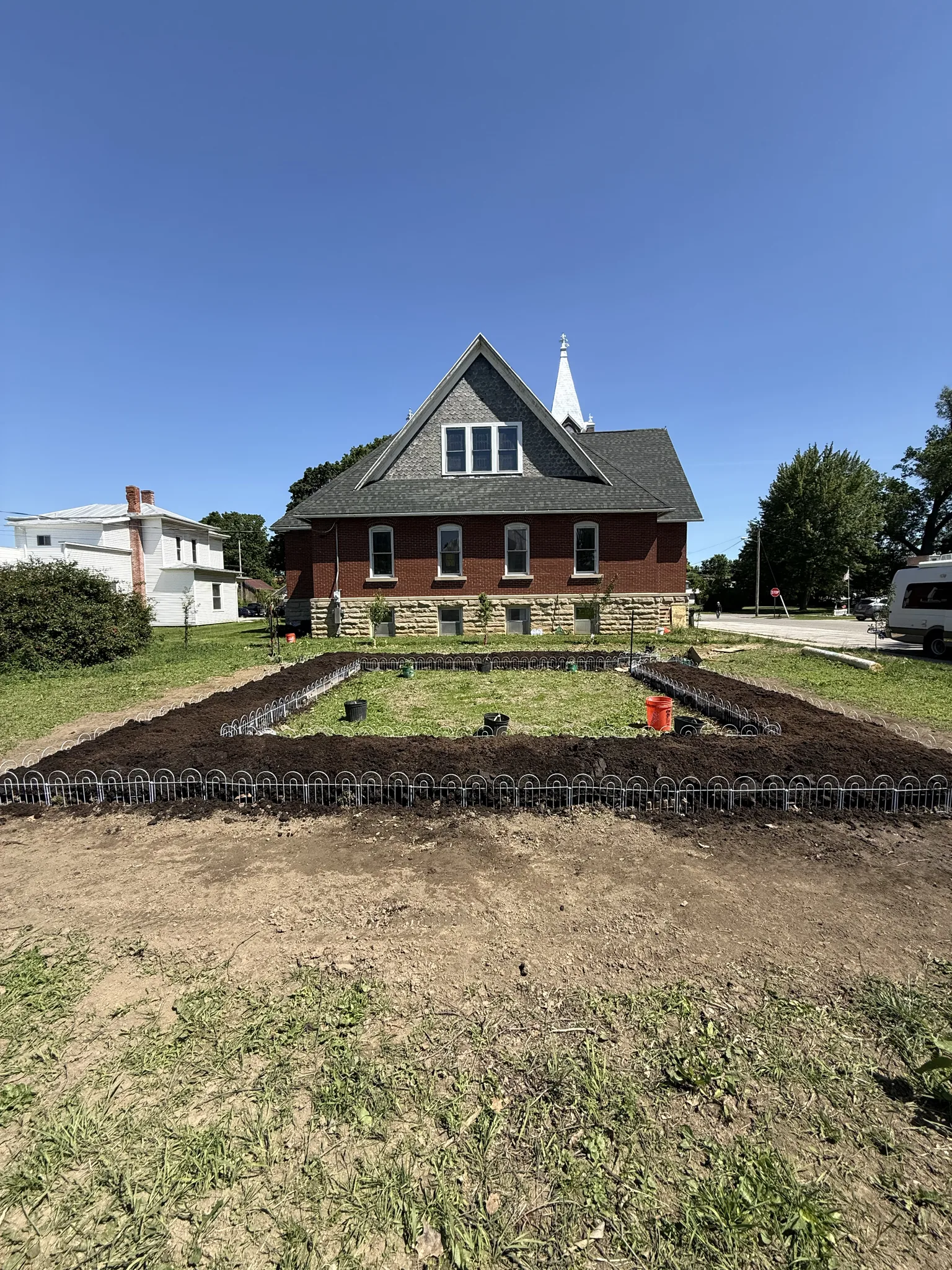
The StarGarden
A garden planted from the sky — and an invitation to begin
Welcome to our StarGarden!
Imagine a garden laid out not by rows or by what's on sale at the nursery, but by the sky.
Picture twelve square beds laid out clockwise, the way the southern Indian jyotish chart is drawn — one bed for each slice of the heavens, one constellation, one season, one chapter of a human life. And in each bed grows a small community of plants chosen because they belong there: they carry the flavor, the medicine, the temperament, and the lesson of that slice of sky.
Walk the square and you are walking through the whole year, the whole zodiac, and — if you let it — the whole of a human life. The plant that feeds you is also teaching you. The bed that needs weeding is also the corner of your life asking for attention.
That is the StarGarden. It is a real garden at Forest Sanctuary, and it is also a living map — a way of using nourishment, season, and beauty to bring the twelve areas of your life into a kind of balance. We sometimes call it a work of performance art, because the "performance" is simply a person living in rhythm with the cosmos, one tomato and one quiet morning at a time.
You do not have to believe anything to enjoy it. You only have to be willing to look up, and then look down at the soil, and notice that they rhyme.
The old idea underneath it
For almost all of human history, in nearly every culture, people read the sky to know when to plant, when to harvest, when to rest, and how to understand themselves. The agricultural calendar and the astrological calendar were the same calendar. "As above, so below" was not mysticism — it was farming.
The StarGarden draws its particular structure from Jyotish (pronounced JYOH-tish), the star-knowledge of the Indian subcontinent. The word means "the science of light." It is one of the oldest continuously practiced systems for relating the rhythm of the heavens to the rhythm of a life. We use its framework the way a composer uses musical notation: not as a fortune-telling gimmick, but as a precise, time-tested language for organizing pattern, season, and meaning.
If that word astrology makes you wary, good — read the FAQ below, where we meet that worry head-on. This is a contemplative and seasonal practice, not a prediction machine.
The four ideas you need
You can explore the whole garden holding just four simple ideas. Everything else is detail you can pick up as you wander.
Twelve Houses
The rooms of a life
The chart is divided into twelve houses. Each house is one domain of human experience: your body and vitality, your resources, your communication, your home and roots, your creativity, your daily work and health, your partnerships, and so on, all the way around. Think of them as the twelve rooms every life contains. A bed in the garden = a house in your life.
Twelve Signs
The flavors of the sky — Rashis
Each house is paired with a rashi, a sign — the same twelve you may know from Western astrology (Aries, Taurus, Gemini…), here called by their Sanskrit names. Each sign has a character, a mood, a way of moving through the world. The plants in each bed carry that character.
Elements & Modalities
The grammar
Every sign is built from an element (Fire, Earth, Air, Water — plus Ether, the space that holds them) and a modality (Cardinal = initiating, Fixed = sustaining, Mutable = adapting). These are the few building blocks that, combined, give all twelve signs their distinct personalities. Learn five elements and three modalities and you can “read” any sign from scratch.
The Doshas
The garden as medicine
Here is where the garden feeds your body, not just your imagination. From Ayurveda, jyotish’s sister science of health, comes the idea of three doshas — Vata (air/space), Pitta (fire/water), and Kapha (earth/water) — three basic tendencies in every body and every plant. Each plant in the StarGarden carries a taste (rasa), a heating or cooling energy (virya), and a medicinal action.
How to walk in — there is no single front door
The most beautiful thing about the StarGarden is that you can enter from wherever you already are:
Every plant has its own page. Every sign, house, element, and trouble has its own page. And they all link to each other, so you can follow a thread as far as your curiosity takes you. That web of connections — that is the interactive StarGarden lab, the heart of this whole site.
The invitation
Once you've wandered, the invitation is simple: plant a little of it yourself, where you are.
You don't need an acre or a mandala. A few pots on a balcony, chosen with intention — one plant for a corner of your life that needs tending — is enough to begin. All of our seed varieties are heirloom, sourced from Baker Creek Heirloom Seeds, so what you grow can be saved and passed on, season after season.
The deeper practice is rhythm: rising with a quiet moment, eating what the season offers, letting the year turn you the way it turns the garden. Jyotish gives the notation; nourishment is how you play it; your own life is the music. That is the cosmic dance — and you're already in it. The garden just helps you feel the beat.
Frequently Asked Questions
All seed varieties courtesy of Baker Creek Heirloom Seeds (rareseeds.com). Medicinal and Ayurvedic information on this site is offered for education and contemplation, not as medical advice.