Vedic Key
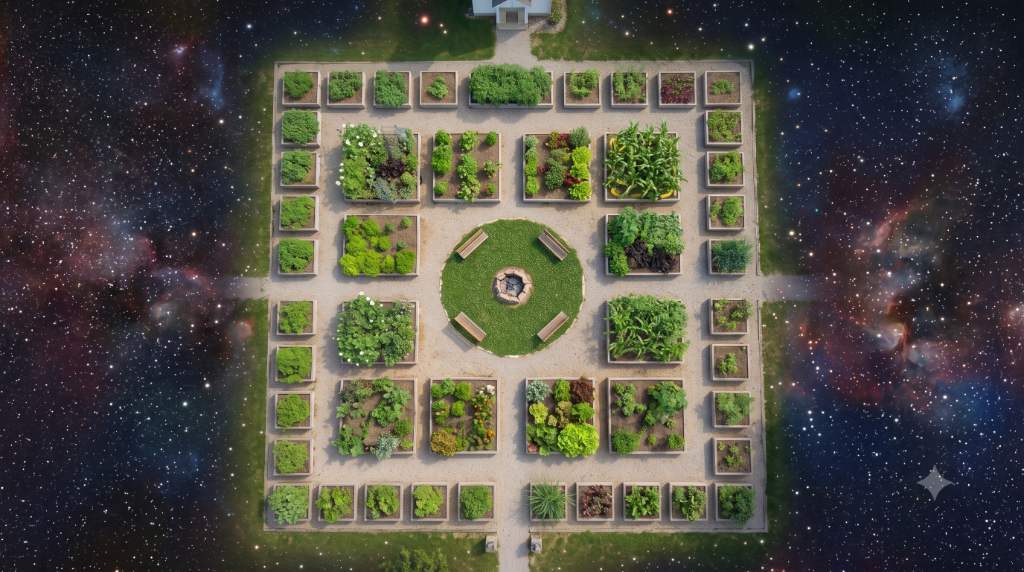
The Navagraha Mandala Garden — the StarGarden rendered as a living chart you can walk.
Twelve rashis around a central fire, twenty-seven nakshatras at the perimeter — the whole StarGarden in one view. Every bed and every plant finds its place in the sky.
* Turmeric, ginger, holy basil, and chickpeas marked with an asterisk are summer-only in Zone 6a — plant after last frost, or grow in containers brought indoors for winter.
Reading the Mandala
Center
Fire pit ringed by Dutch white clover. The gathering hearth — Agni, the bindu, the point of stillness from which the chart radiates.
Inner Ring · 12 Rashis
South Indian kundali layout. Signs are fixed in position; Pisces top-left, then clockwise. Each plot holds a primary plant and 3–4 companions.
Outer Ring · 27 Nakshatras
The lunar mansions, each with its assigned vegetable. The Moon transits one nakshatra per day — daily ritual updates the outer marker.
Movable Grahas
Nine sculptural spheres (Sun, Moon, Mars, Mercury, Jupiter, Venus, Saturn, Rahu, Ketu) plus an ascendant marker. Anyone may place them by their natal or current chart.
Notes for Forest, Ohio · Zone 6a
The tropical Ayurvedics
Turmeric, ginger, holy basil, and chickpeas marked with an asterisk are summer-only in 6a. Plant after last frost (~mid-May), harvest before first frost (~early October), or grow in containers brought indoors for winter. They keep their planetary assignments regardless.
No-dig method
Each plot built as a Charles Dowding bed — cardboard base directly on the existing turf, 4–6 inches of compost on top, plant straight into the compost. Mulch with straw or wood chips for paths. The earth is not turned; the soil web stays intact, which is consonant with the spiritual frame of not disturbing the ground unnecessarily.
Orientation & vastu
- Ascendant point at the eastern edge — sunrise direction, where the rising sign enters the chart.
- Movement is clockwise (pradakshina) when reading transits or houses.
- Northeast corner (Ishanya) is the most auspicious in vastu — consider placing your meditation seat or the entrance there.
- Southwest (Nairutya) is the heaviest, most grounding direction — the Ketu nakshatras and Saturn-ruled rashis sit naturally on this side.
Using the garden as instrument
The garden is a working orrery, not a static decoration. Three layers of practice are possible:
Natal placement
Set the grahas on a visitor’s birth chart. They walk their own kundali.
Daily moon
Each morning, move the moon marker to today’s nakshatra. Observe which vegetable is being “blessed” that day.
Transit observation
Update Saturn and the outer grahas monthly, the inner grahas weekly. Watch the sky live in the soil.
What the garden teaches
Not a magic object but a discipline of attention. The traditional Ayurvedic plants do real medicinal work; the daily walking-of-the-chart is a real contemplative practice; the growing food sustains real bodies. Healing happens through participation — sowing, weeding, harvesting, observing — not through proximity. The mandala is the field; the practice is yours. Moksha is the silence at the center where you sit.
Walk it in the soil
The mandala is planted out back — twelve beds you can walk through. Come see the StarGarden.
Enter the StarGarden
